

We’ve all been there. Maybe it’s a spilt cup of coffee on a busy morning, a stubborn traffic jam, or a heated disagreement with a loved one. Suddenly, a wave of heat rushes through your body. Your heart races, your jaw clenches, and before you know it, you’ve snapped. You yell, you slam a door, or perhaps you completely shut down and tune out.
Later, once the storm has passed, a wave of regret washes over you. You think, “Why did I react like that? That wasn’t like me at all.”
First, let’s take a deep breath together and normalise this: You are not broken, and you are not a bad person. What you experienced is a completely natural, built-in human survival response. When we lose control, our brains are simply trying to protect us—even if their method is a bit messy.
Understanding exactly what happens in your head during these moments is incredibly empowering. It shifts you from feeling like a victim of your emotions to being the driver of your own body. To see how this works, we can look at a brilliant blueprint created by a psychiatrist named Dr. Dan Siegel, called the Hand Model of the Brain, and connect it to a tool called the Zones of Regulation.
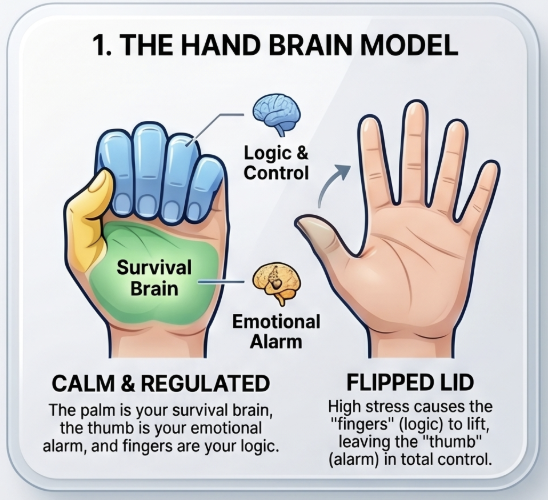
Your Brain in the Palm of Your Hand
Imagine your hand is your brain. Hold it up, tuck your thumb into your palm, and fold your four fingers down over your thumb. This is a mini-model of what’s going on inside your skull.
- Your Palm & Wrist (The Downstairs Brain): This represents your brainstem and cerebellum. It controls basic bodily functions like breathing, heart rate, and balance.
- Your Thumb (The Emotional Alarm): Tucked safely in the middle is your amygdala. This acts as your body’s smoke detector. Its only job is to scan the world for danger and keep you safe.
- Your Fingers (The Thinking Brain): Folded over the top is your prefrontal cortex. This is your “Wise Leader” or “Wise Owl”. It is the part of you that thinks logically, solves problems, manages emotions, and communicates calmly.
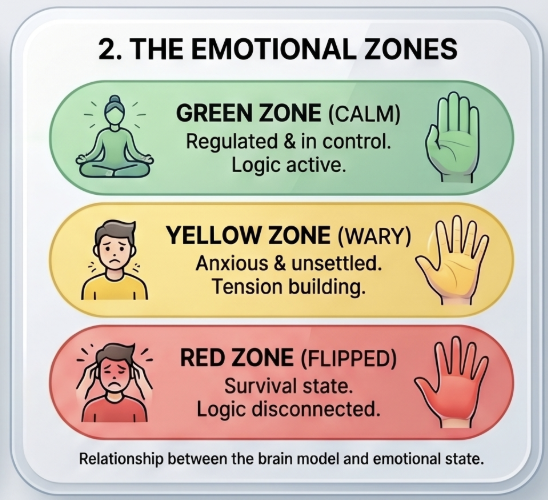
When your fingers are folded neatly over your thumb, your brain is integrated and regulated. All parts of your brain are working together as a team. In the world of emotional wellness, we call this the Green Zone. When you are in the Green Zone, you feel calm, happy, relaxed, and ready to handle life’s bumps with patience and logic.
What Happens When We “Flip Our Lid”
Now, imagine that stress piles up. You are exhausted, overwhelmed, and suddenly a perceived threat or trigger occurs. Your Emotional Alarm (the thumb) registers this stress as a massive safety hazard.
In a split second, it hijacks the entire system. It decides there is no time to think logically.
Now, lift your fingers up physically. This is what is known as flipping your lid.
When you flip your lid, your Thinking Brain (your fingers) is disconnected from the rest of the system. The wise, logical leader has left the building. Instead, your raw Emotional Alarm (the thumb) is left completely exposed and running the show.
This takes you straight into the Red Zone. In the Red Zone, you are completely unregulated. Your brain enters primal survival mode, triggering responses like Fight (shouting, screaming), Flight (running away, escaping), or Freeze (shutting down, going numb). When your lid is flipped, it is biologically impossible to reason or learn. You cannot do your best thinking because the “thinking tool” is literally offline.
(Note: Sometimes our lid is only halfway lifted—this is the Yellow Zone. You might feel fidgety, anxious, worried, or overly excited, meaning the team in your brain is struggling to work together, but hasn’t completely broken down yet.)
How to Get Back to the Green Zone
The secret to emotional control isn’t about preventing yourself from ever getting stressed. That’s impossible. The secret is learning how to manually fold your fingers back down to get your brain back online.
Because your logical brain is disconnected during a blowout, you cannot “think” your way out of a Red Zone explosion. You have to talk directly to your physical body. When you calm the body, the alarm turns off, signalling to the fingers that it is safe to fold back down.
Here are two practical, jargon-free tools to bring your Wise Leader back to the steering wheel:
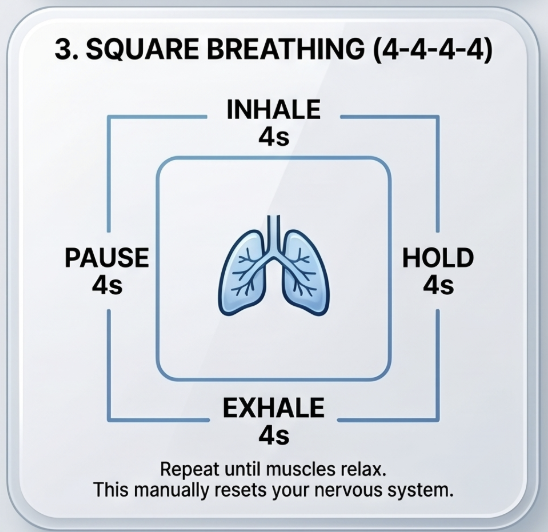
Square Breathing (Box Breathing)
Your breath is the ultimate remote control for your nervous system. When you are in the Red Zone, your breathing becomes fast and shallow. Deep, structured breathing forces the emotional alarm to shut off.
- Breathe in through your nose for a count of 4.
- Hold that breath for a count of 4.
- Exhale gently through your mouth for a count of 4.
- Pause with empty lungs for a count of 4.
- Repeat this cycle 3 to 4 times until you feel your muscles relax.
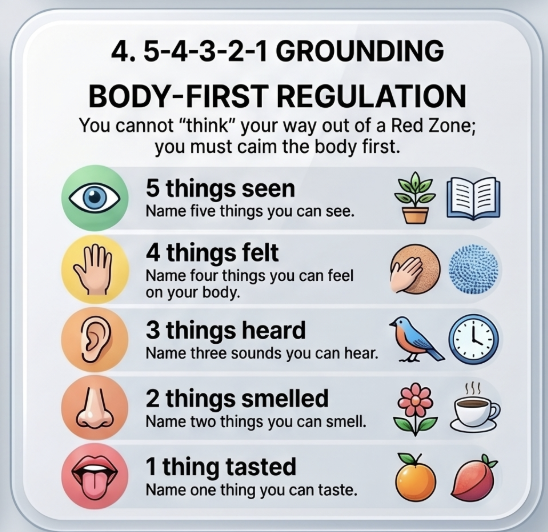
The 5-4-3-2-1 Grounding Method
When your mind is racing or reactive, this tool anchors your brain back into the physical safety of the present room. Look around you and slowly name:
- 5 things you can see (a clock, a chair, your shoes).
- 4 things you can physically feel (the fabric of your pants, the hard floor).
- 3 things you can hear (a fan humming, birds outside).
- 2 things you can smell (coffee, soap).
- 1 thing you can taste (the mint from your toothpaste).

Knowledge is Your Superpower
The next time you feel a wave of intense anger or anxiety, picture your hand. Pause and recognise it: “Ah, I am starting to flip my lid. I am moving out of the Green Zone.”
Instead of beating yourself up for being overwhelmed, remember that it is okay to experience these colours. But now that you know the blueprint, you have the power to ask yourself: What do I need right now to get my brain back online? By taking a deep breath or grounding your senses, you are manually calming the alarm and stepping back into control.